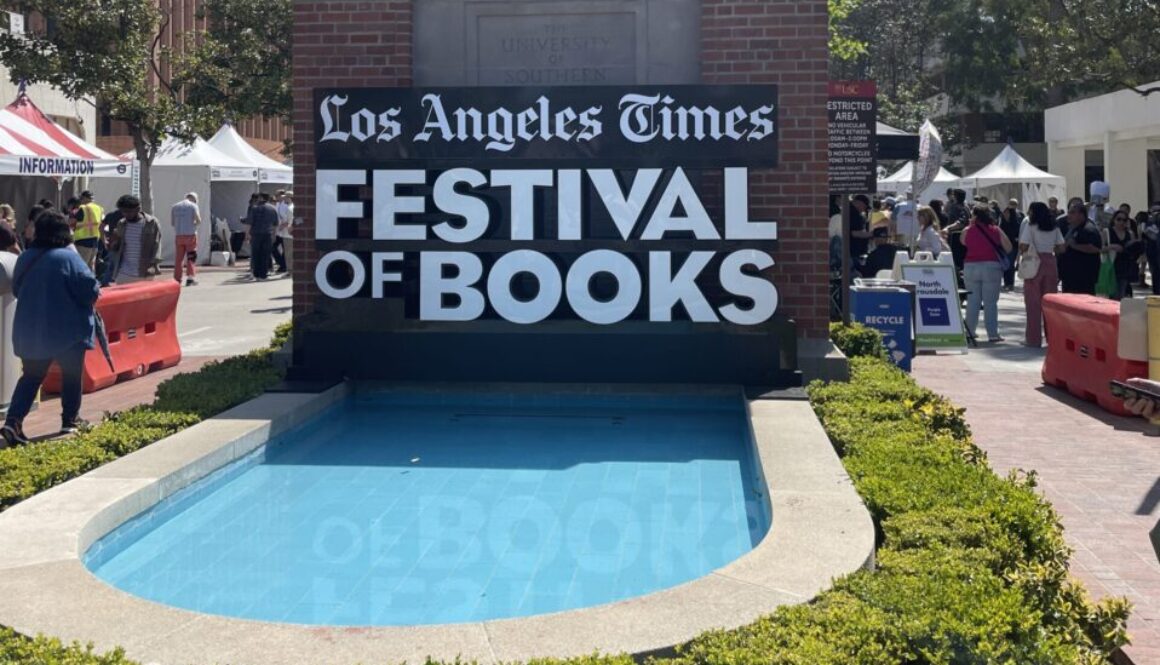
The panel I was most excited for and the only one I reserved tickets for at the 2024 Los Angeles Festival of Books was a panel entitled California State of Mind: Publishing in the West. As a current Portlander, I was mildly surprised that they were not considering publishing in other states considered “The West” such as Washington and Oregon or Arizona and Nevada; however, as a native Southern Californian, a part of me understood why this panel was focusing on California specifically, especially because most exhibitors were CA-based.
The panel consisted of Michelle Tea of Dopamine Press, Steve Wasserman of Heyday, Kate Gale of Red Hen Press, and Chris Heiser of Unnamed Press, and was moderated by Laura Cogan of ZYZZYVA literary magazine. It was originally described as:
For decades, New York has been considered by many to be the publishing epicenter of the United States. But California has a rich literary history and a thriving literary present, as evidenced by the publishing houses, bookstores, writers, universities, and communities that call the Golden State home. Join us for a lively discussion on the state of publishing and literature in California with some of the industry’s foremost experts in the field.
I found this description particularly interesting and relevant as my master’s thesis originally was going to include publishers in California before I realized the scope of that research was too great for that particular paper. As someone with a stake in both California and Oregon publishing, I hope to consider both viewpoints in this post and examine the wealth of both landscapes, especially in the context of my current attempt to join publishers across the U.S. as an editorial assistant.
California Publishing
I think there is a general impression that publishing in California is a relatively recent development. Unnamed Press is 10 years old, Red Hen Press is 30, and Heyday is 50 years old this year. The general tone was that Heyday was more remarkable for being 50 years old, and while it is impressive for an independent publisher to exist for so long, the 1970s had a wealth of publishing happening in California. “In California, Book Publishing Takes on New Forms,” a 1979 article by The New York Times, expresses “California book publishing listens to the sound of different drumbeater” while describing a unique “romance” between books and screen through Hollywood and an estimated “one‐fifth of national publishing revenues originate [in California]. That would mean that California accounts for $1 billion of the $5 billion national total.” A fact that remains true in publishers such as Level 4 Press whose mission is to “create entertaining, thought-provoking books that are destined to be great films and television series.”
However, one of the most interesting analyses of California publishing is the difference in the willingness to take risks. For example, “The far more positive side of West Coast publishing is that many small and independent houses turn out books that represent the state’s laid‐back approach to life. Some take risks without regard for the big sales numbers that New York publishers often deem necessary before acquiring a book.” At the panel, Wasserman of Heyday expressed the importance of being in control of your expectations as an author and how if your goal is to be published then self-publishing is a great way to end up with a book-like object. Alternatively, working with a small, independent publisher whose print run is only a couple thousand means that you can have a wider distribution but may not have the sales or author tours that many expect from larger publishers. In my opinion, the biggest advocate for your book is you and no matter the initial print run, an author may be capable of drumming up more attention and readership than anticipated.
The 1979 article also ranks the level of market expectation and willingness to take risks as San Francisco with the most risk publishing books to Los Angeles with the desire to make books profitable to the silver screen to New York more focused on big sales numbers. The article also illustrated topics that other California publishers cover including conservation, nuclear energy, natural sciences, medicine, marijuana, and specialized books that “look across the Pacific to the South Seas and Japan for specialized books that have absolutely no movie tie‐in potential.”
Further, as Wasserman of Heyday mentioned, the pandemic led to the proliferation of the environmental book. This is evident in recent LA Times book award finalists in the science/technology category. Before 2020, the finalists in this category consisted more of human-based science, including data, medicine, drugs, biology, and AI. Starting in 2020, more environmental books were named finalists (two in 2020 and peaking in 2022 with four out of five finalists focusing on nature-centric topics: How Far the Light Reaches: A Life in Ten Sea Creatures by Sabrina Imbler, Life on the Rocks: Building a Future for Coral Reefs by Juli Berwald, Fresh Banana Leaves: Healing Indigenous Landscapes Through Indigenous Science by Jessica Hernandez, Beyond Measure: The Hidden History of Measurement from Cubits to Quantum Constants by James Vincent and An Immense World: How Animal Senses Reveal the Hidden Realms Around Us by Ed Yong).
There seems to be a challenge in California to have the same casual, in-person conversations that those in New York offices might have due to the more spread-out nature of California as a whole and, more specifically, Los Angeles expanding out while New York expands up. However, as a 2018 Los Angeles Magazine article describes, publishers like Unnamed Press, Red Hen Press, and Prospect Park are making efforts to build community and lean into the diversity that Los Angeles provides.
There seems to be a general perception, at least in my opinion, that California still embodies the Wild West, that it is the place to go to take risks and become the person you want to be. The American Dream living on in Hollywood performers, Youtubers, and others who want to “make it big,” and I still think that California (and the rest of the West Coast) is still growing in potential for this risk-taking when it comes to publishing.
Another article that I find fascinating but don’t have time to expand upon is a Publishers Weekly article from 2007 taking note of publishers in NorCal: “Northern California: A Publisher for Every Taste.”
Publishing in the West: Beyond California
Many of the innovations of California publishing are true for other regions. I know more about Pacific Northwest publishing, so I will be focusing on that, but many other places have prolific and innovative literary scenes (Chicago, Boston, and Minneapolis come to mind).
A sticking point at the panel was that while the creation of books has been democratized through a boom of independent publishers, distribution is still relatively monolithic. With the recent closure of Small Press Distribution, there is even more of a struggle for small presses to distribute. (Even then, before its closure, SPD also had a deal with Ingram as their stock was transferred in February of this year to “facilities owned by the Ingram Content Group and Publishers Storage and Shipping.”)
Microcosm Publishing in Portland is an innovative publisher who, at the end of 2018, chose to self-distribute and stop offering their titles on Amazon. Now they not only distribute their own titles but also titles from other publishers. At this year’s PubWest trade show in Maricopa, Arizona, Microcosm’s publisher Joe Biel won the inaugural Innovator’s Award.
In addition, Mountaineers Books out of Seattle is using Faire (used for wholesale orders for small businesses) to reach nontraditional gift retailers.
The Oregon Book Award finalists also reflect the increased interest in environmental books as their Frances Fuller Victor Award for General Nonfiction finalists included Jessica Applegate and Paul Koberstein’s, Canopy of Titans: The Life and Times of the Great North American Temperate Rainforest, Steven C. Beda’s Strong Winds & Widow Makers: Workers, Nature, and Environmental Conflict in Pacific Northwest Timber Country, Tove Danovich’s Under the Henfluence: Inside the World of Backyard Chickens and the People Who Love Them, Jacob Mikanowski’s Goodbye, Eastern Europe: An Intimate History of a Divided Land, Josephine Woolington’s Where We Call Home: Lands, Seas, and Skies of the Pacific Northwest.
You can find more background on publishing in the PNW in my master’s research on the home page of my website. In addition, a particularly interesting research paper is “An ‘‘Accidental Profession’’: Small Press Publishing in the Pacific Northwest” by Melanie Ramdarshan Bold published in Publishing Research Quarterly. I would also give the Publishers Weekly article “PLA & Pacific Northwest Spotlight: Publishing in the Pacific Northwest” a read.
In Contrast to New York
Because New York is part of the original question of the panel, I want to talk about how publishing in New York interacts with a more broad publishing landscape. New York City is solidly the epicenter of publishing. While it is not the only place publishing happens, as clearly outlined above, the proximity of the people working at the Big 5 makes it easier for collaboration through in-person meetings such as lunch or coffee or simply dropping by a different floor in the same building. This is one reason that COVID felt like a shift was coming to publishing, like the in-person meetings and proximity didn’t matter anymore. It wasn’t happening.
On the back of COVID, many people became remote and created a new way of completing work from afar. It led to remote internships and remote hiring and had a lasting impact in that many internships are still remote, some jobs are still “open to remote” candidates, and hybrid working is more visible and viable. The flexibility that COVID forced on publishers proved that employees didn’t need to actively be in the office at all times. The downside of this flexibility is that I don’t see it extending to everyone equally. Most people who can continue working from home are managers or people higher up in many organizations, not exclusive to publishing. In addition, I am suspicious of any jobs that are “open to remote” as many of them are only open to people in New York or New Jersey, only open to certain states, or request at least one day a week in person.
As someone who is still early in my publishing career and looking to enter my next in-house job as an editorial assistant, I find it difficult to find entry-level positions outside of publishers based in New York, many of which don’t offer remote entry-level positions. In addition, entry-level positions tend to pay roughly $45,000 which is not nearly enough to move across the country and reestablish myself in New York City, which already has a high cost of living. This is not an isolated opinion. One of the blogs I edited at Ooligan Press entitled “Sorry New York, Not Everyone❤️s You: It’s Time for Publishing to Diversify” showcases some of the difficulties in trying to make that move and proposes that Big 5 publishers consider creating offices on the west coast, as many have done in the past in San Francisco and the surrounding Bay Area, to create in-person opportunities for people outside of New York to compromise on the desire to be affordable and in person. Another fellow grad student at Ooligan Press examined the cost of living in New York in relation to entry-level salaries in her thesis “Struggling to Thrive: NYC Publishing Salaries in the Age of Inflation & Implications for Diversifying the Publishing Workforce”.
It seemed to be that the panel was more focused on the rivalry between LA and NYC and the thought that a person from California or Los Angeles could not break into publishing. However, the real issue is that it is more difficult for people outside of New York to reach the same level of career progression as those who are based in New York. In addition, while graduate programs and institutes for publishing and editing exist outside of New York, it may be difficult to make the same connections when based beyond New York, and potentially other East Coast cities.
As a whole, it seems like the “The West” goes as far as to include California, Oregon, Washington, Idaho, Montana, Nevada, Colorado, New Mexico, Utah, Arizona, Alaska, and Hawaii (at least according to the Census Bureau). However, it seems like it is divided into the Pacific Northwest, the Southwest, and California on its own. I would love to see more collaboration between regions supporting each other like the community presented at conferences like PubWest. Apologies for the long blog post; thanks for sticking around.